How to Do Visual Comedy
How to do visual comedy like filmmaker Edgar Wright.
via kottke

Electronic Arts alumnus Bob Nystrom’s Game Programming Patterns is shaping up nicely to become a must-read for game developers.
You can start reading the book online and follow and comment on the work in progress at the code-sharing website GitHub.
New York-based motion designer Cento Lodigiani takes inspiration from Frank Thomas and Ollie Johnston’s 1981 animator’s bible, Disney Animation: The Illusion of Life, in creating his visual exposition of the basic techniques of classical animation.
(via Cento Lodigiani)
Educational Tate web short, sketching out the origins of time-based art. Written by art critic Jessica Lack.
(via Tate)
Reid Gower produces short, inspirational films to raise awareness of science education. It’s a job that he does well: the Sagan Series of science videos has so far been viewed by millions worldwide. By recently making the project ‘open source’ however, Gower is hoping that others will contribute.
Watch his latest media creation, the audaciously titled ‘Think Like A Martian’, above — which borrows the words of the late theoretical physicist Richard Feynman, one of the great voices of popular science. Or browse the entire Feynman Series here and its aforementioned companion series dedicated to astronomer Carl Sagan here.

Over 100 users on the popular collaborative code sharing host GitHub have resurrected and updated an A–Z of free programming books that first appeared on Q&A site StackOverflow. The list is a wonderful reading resource for enlightened coders and developers to delve into, perhaps looking to learn another programming language or to fill gaps in their knowledge.
If you’re searching for solid grounding in programming, then you might like MIT’s Harold Abelson and Gerald Jay Sussman’s influential ‘Structure and Interpretation of Computer Programs’. Intermediate coders will enjoy the pearls of wisdom selected for O’Reilly’s ‘97 Things Every Programmer Should Know’ (available in its original text). My favourite, ‘The Nature of Code’ by Daniel Shiffman, explores ‘generative’ and computational design.
You can browse the exhaustive bibliography here on GitHub.
ASIDE: If you’re new to coding then you might start with Codeacademy’s interactive learning modules and Harvard’s OpenCourseware Introduction to Computer Science and Programming lectures, both of which are excellent and free, but not currently listed.
Simple but informative history lesson on the discreet art of framing screen action.
(via BoingBoing)
The solitary struggle with problem-solving, depicted with wry comedy. Written and directed by Steve Simmons.
(via Silent London)
Excerpt from Mick Gold’s Europe After The Rain, 1978, Arts Council of Great Britain — an in-depth, if somewhat curious documentary of the work of the leading exponents of Dada and Surrealism.
See for yourself here.
Introduction to the activities of agit-art movement Situationist International.
TED-Ed has announced that it will add Jessica Oreck’s etymological mini-series, Mysteries of Vernacular, to its online video library over the next months. As Jessica plans to create 26 lessons — one for each letter of the alphabet, bringing stories of everyday words to life using paper cutouts and stop-motion animation — this is wonderful news.
(via Jessica Oreck and TED-Ed blog)
Author and academic David Lodge (How Far Can You Go?, The Campus Trilogy) narrates this gently sardonic three-part Channel 4 documentary about the social phenomenon of academic conferences.


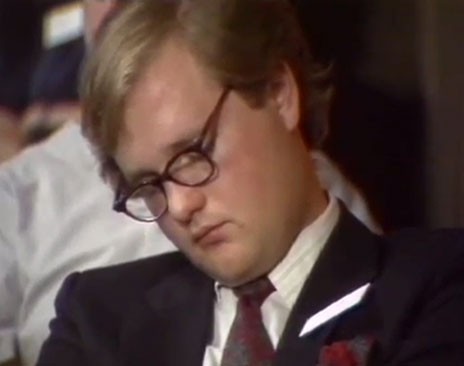
When dissent amongst a polarized audience of literary theorists and linguistics scholars interrupts the proceedings of the Linguistics of Writing Conference, 1986, at the University of Strathclyde, the conference itself becomes the subject of a farcical debate between conferees, speakers and the documentary filmmakers.
Watch Part 1, Part 2 and Part 3 of Big Words, Small Worlds, blissfully archived by University of Pittsburgh.
Contributions from novelist and critic Raymond Williams, celebrated philosopher Jacques Derrida, writer and critic Stanley Fish, MIT Professor of Linguistics Morris Halle, Professor of Languages and Literatures Marie Louise Pratt, cultural theorist Stuart Hall, slang lexicographer Jonathon Green, writer and academic Willy Maley, documentary filmmaker Pratap Rughani, writer and poet Benjamin Zephaniah, avant-garde filmmaker Jean-Luc Godard, and others from an attendee list that reads like a Who’s Who in literary and linguistics criticism.
Landfill Harmonic is an upcoming feature-length documentary about a remarkable musical orchestra in Paraguay, where young musicians play instruments made from trash.
More information here.
Recently launched online repository of experimental fonts. Managed by graphic design students at University of Salford.

To pay tribute to the art critic Robert Hughes (1938–2012), the BBC recently broadcast The Shock of the New — the outstanding 1980 documentary TV series in which Hughes reappraises modern art, architecture and design within a social and historical context.
At best, Hughes’ droll and rather pugnacious manner of speaking is entertaining; the imaginatively themed episodes, however, are stimulating and educational.
All eight episodes are available to watch on YouTube (via OpenCulture): The Mechanical Paradise, The Powers That Be, The Landscape of Pleasure, Trouble in Utopia, The Threshold of Liberty, The View From the Edge, Culture as Nature and The Future That Was.
Okay, I admit: I completely missed this Open University Learn animation series first time round. Seven adventures in philosophy, science and mathematics explicated with ingenuity and wit by Angel Eye Media (narration by David Mitchell).
(via OpenLearn)
This is a seductive short about the making of process printing ink. Wonderful.
(via kottke)
Hilarious comedy sketch from the BBC TV series A Bit of Fry and Laurie (1995).

The Graduate Academy will teach graduates about their role in a creative organisation. It will show them how to bring their education-based skills into a work setting, how to view their work objectively and how to contribute as a member of a team.
100 final-year students and recent graduates will be attending the D&AD Graduate Academy this August. The top 50 will then be selected to go forward for a 3 month *paid* placement at a creative organisation in the UK. Fabulous opportunity for new creative professionals.